
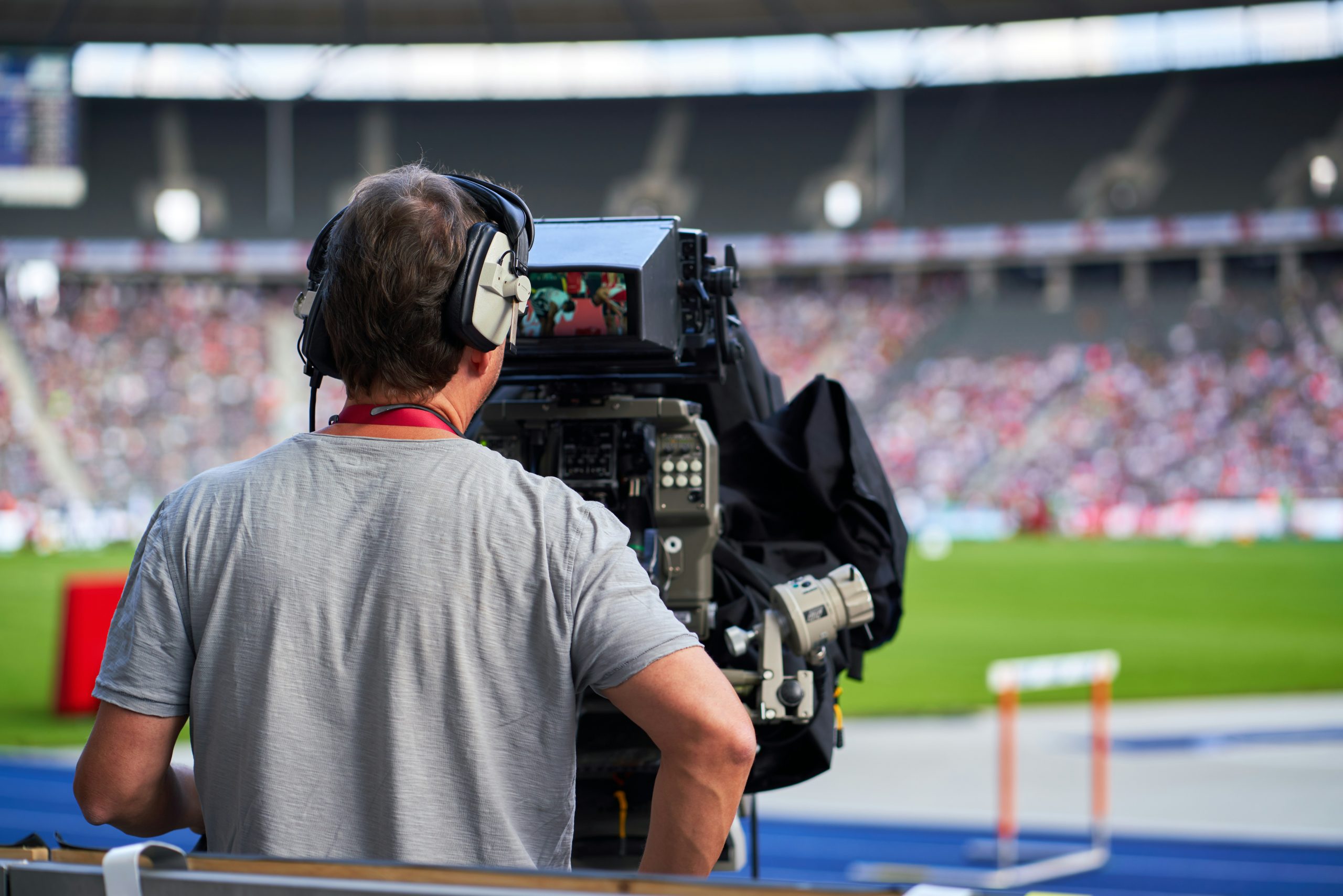
Anyone who has watched enough Saturday football knows the picture on your screen is a production feat that would have been unthinkable a generation ago. Go back far enough and college football broadcasts were a single camera parked at the 50-yard line, a fixed wide shot that turned a first-down conversion into a distant scramble of numbers. There was no isolation on the quarterback’s eyes before the snap, no sideline reverse angle, no pylon cam catching a toe tap in the corner of the end zone. That era is long gone. Modern NCAA football and basketball coverage runs on a wall of cameras — high-home, low-end zone, handhelds, skycam, robotic rail units — feeding a control room that cuts between angles in real time. Just as important, the latency shrank. What used to be a satellite delay measured in seconds is now a low-latency stream where a viewer at home reacts to a buzzer-beater almost as fast as the fan in the arena. Layer on interactive streams, second-screen stat overlays, and live chat, and the modern broadcast stopped being a window you watch and became a room you sit in.
The Same Production Logic, A Different Studio Floor
Here’s the part that connects back to sports media in a way that isn’t obvious until you see it side by side: the live-dealer casino format borrowed the entire broadcast playbook. A live-dealer table is essentially a small sports control room. A real dealer works a real table under studio lighting, tracked by a multi-camera rig — a wide shot on the whole table, a tight overhead on the cards or wheel, and a dealer-facing camera for the human element. A director-equivalent switches those feeds. Optical character recognition reads the cards and the wheel the way a stat graphics operator reads a play, pushing results to the screen in real time. None of this works without serious rendering and image-processing muscle behind the scenes — the same class of real-time visual optimization we’ve covered in our look at the best apps for improved graphics on Windows, scaled up to a broadcast studio. And the latency problem is identical. A blackjack player deciding whether to hit, or a roulette bettor getting a wager in before “no more bets,” is doing the same thing a viewer does when a fourth-down call hangs in the balance: reacting to live action where a two-second delay ruins the moment. The whole category lives or dies on the same low-latency, multi-angle, interactive-chat foundation that college sports broadcasting spent decades perfecting.
What Canadian Players Actually Experience
For players north of the border, this broadcast-grade production is now the baseline expectation rather than the exception. On licensed platforms in regulated markets — Ontario’s iGaming framework being the most developed — the live-dealer experience mirrors what sports fans already recognize: HD multi-camera studios, dealers who greet you by handle, in-game chat that reads like a broadcast comment section, and real-time betting decisions made against a running clock. The production values differ from operator to operator, and a rundown of current live casino sites for Canadian players and how their studios stack up can be found here in the National Post’s guide, which compares the operators serving the Canadian market today. As with any live broadcast, the platform and production quality end up mattering as much as the event on the table.
Keeping the Broadcast Frame Honest
There’s a limit to how far the sports-broadcast comparison should go, and it’s worth naming. A telecast asks for your attention; a live-dealer table asks for your money. The interactive chat, the real-time decisions, and the immersive studio feel are engineered to keep you engaged, and that engagement carries real financial risk that no football broadcast does. Canada’s Responsible Gambling Council has spent more than 40 years on exactly this problem, and their resources on setting limits and recognizing risk are the responsible starting point for anyone treating these platforms as entertainment. Watch the production if you appreciate the craft — it’s genuinely a broadcast achievement lifted from the sports world. Just remember which side of the camera the stakes are on.
